
t3rn 2026 Roadmap: Cross-Chain Smart Contracts, Trustless Infrastructure - Migrating to Autonomous Solvers Economy
In July 2025, we launched the t3rn protocol with a clear hypothesis: trustless
smart contract settlement would be a sufficient foundation for a revenue-generating
bridge. The contracts worked exactly as designed—no custody risks, cryptographic
proofs, deterministic execution. The economics didn't.
The infrastructure we shipped reflected our testnet experience. During testing,
we'd seen massive transaction flows— up to 800 of orders per minute, sustained API
load that required serious architectural planning. We built for that scale: AWS
auto-scaling groups, distributed caching layers, redundant monitoring systems,
multi-region deployment.
That infrastructure handled the testnet load; the problem was that
mainnet traffic never reached those levels.
What we got instead was sporadic volume—spikes during promotional periods, then
sustained low-throughput operation. The revenue from transaction fees barely
covered gas costs, let alone infrastructure expenses. Meanwhile, AWS bills arrived
monthly for systems engineered to handle 100x our actual load.
The auto-scale architecture that was essential for testnet became a massive
operational burden in production. We're paying for redundancy we don't need,
scaling capacity we don't use, and monitoring systems watching mostly idle
infrastructure.
The math is simple: current monthly infrastructure costs exceed protocol revenue
by a significant margin. That's not sustainable.
The Solution
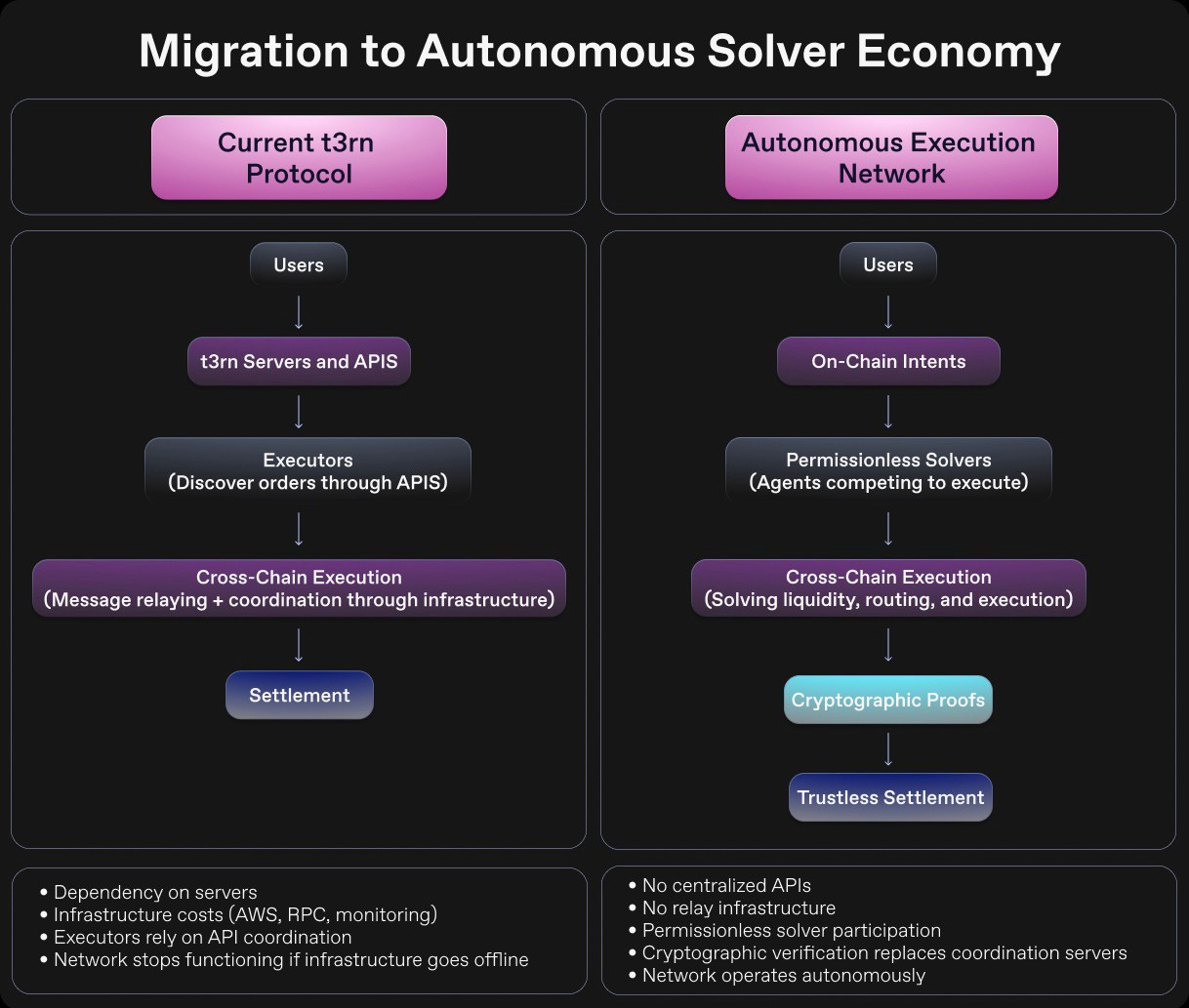
The solution isn't to scale down the centralized infrastructure—it's to eliminate
the operational dependency entirely. Migrate everything that currently runs on our
servers to run autonomously: on-chain order discovery, peer-to-peer message
relay, cryptographic proof verification instead of API coordination.
This isn't only about cost-cutting. It's about finally building what we should have
built from the start: a protocol that operates autonomously, where our
infrastructure going offline wouldn't even be noticed because there's no
infrastructure to go offline.
Executors relied on our APIs to discover orders. Our monitoring services tracked
chain state and coordinated attestations. Our infrastructure handled the message
passing between chains. The trust assumptions were minimal, but the operational
dependencies were real.
This created a contradiction: the protocol could run without trust, but it
couldn't run without us.
Every order processed depended on our servers staying online. Every cross-chain
message required our relaying infrastructure. We weren't custodians, but we were
critical intermediaries. Remove our API layer, and the network stops functioning.
The cost structure reflected this. AWS bills for services that should have been
decentralized. RPC expenses for coordination that should have been peer-to-peer.
Monitoring systems that existed because executors couldn't independently verify
chain state.
We always intended to eliminate this operational layer. The question was when and
how to migrate from "trustless protocol with centralized coordination" to "fully
autonomous, self-sustaining network."
That migration is now the primary focus.
By end of 2026, t3rn becomes fully autonomous: solvers discover work through
on-chain state, verify execution through cryptographic proofs, and coordinate
through smart contracts. No APIs to maintain. No relaying services to fund. No
operational dependencies on any centralized entity.
Core Principles
We are building around three principles:
1 - Proofs replace servers
Execution correctness is verified through cryptographic proofs rather than centralized infrastructure.
2 - Work earns rewards
Executors are rewarded for performing real execution work.
3 - Markets set prices
Open competition between executors drives down fees and improves execution quality.
How the Network Works
For Users
Users submit an intent describing an outcome — such as swapping assets, opening a lending position, or routing liquidity across chains.
Executors compete to fulfill the request, delivering optimal execution without requiring users to manage bridges, multiple gas tokens, or manual claim flows.
For Executors
Executors run agents that monitor the intent network, evaluate profitability, source liquidity, and execute transactions across chains.
After execution, they submit proofs that are verified on-chain, triggering automatic settlement and rewards.
Participation is fully permissionless — anyone can run an executor.
Beyond Cross-Chain Swaps
While cross-chain swaps are the initial use case, the intent model extends far beyond asset transfers.
The same execution layer can coordinate lending, yield routing, liquidation management, treasury automation, and complex multi-chain DeFi strategies.
t3rn becomes a generalized marketplace for decentralized execution, not just a bridge.
Intent Revenue Streams
Cross‑chain swaps are only the first step. t3rn turns intent fulfillment into a generalized execution marketplace where real economic activity — not just transfers — drives value and revenue for executors, solvers, and the protocol.
In this model, users, DAOs, and systematic traders express what they want to happen, and solvers compete to make it so.
Arbitrage & Systematic Trading
Executors can fulfill intents that describe arbitrage opportunities across venues, networks, and liquidity sources:
“Act on price divergence on ETH/USDC between Arbitrum and Base”
“Capture funding rate spreads across roll‑ups”
“Cross‑venue LP token rebalancing”System traders and arbitrage bots benefit from abstraction: they no longer manage bridging, gas, or multi‑step execution logic — t3rn solvers do, and earn fees and spreads in return.
Cross‑Chain Lending & Borrowing
Intent: “Deposit collateral on Chain A, borrow stablecoins on Chain B at best rates.”
Solvers source liquidity, optimize routes, and earn revenue on borrowed amounts, interest spreads, and execution fees.DeFi Strategy Execution & Yield Routing
Users or DAOs express high‑level outcomes like yield maximization or risk rebalancing. Executors translate these into multi‑platform execution paths and capture meaningful execution revenue.Liquidations & Risk Actions
Rather than fixed, isolated liquidation bots, t3rn enables competitive liquidation markets — solvers compete for the best profits while ensuring faster and more capital‑efficient closures.NFT Liquidity & Cross‑Market Settlement
Intents like “Buy on Blur, sell on other networks if net profit > X%” allow executors to extract value from fragmented NFT markets, capturing execution + spread fees.Prediction Market & Outcome Settlement
Protocols can offload settlement logic to solvers via intents, decentralizing and incentivizing fast, correct payouts with execution fee capture.Portfolio Automation & Rebalancing
DAOs can express intents such as “Rebalance endowment: 40% ETH, 30% stable, 30% diversified yield.” Solvers execute across chains and markets, earning execution fees and spread capture.
Liquidity & Settlement
Executors source liquidity through their own capital or external DeFi markets and settle outcomes through cryptographic verification.
This removes the need for large locked liquidity pools and trusted intermediaries, improving both capital efficiency and security.
Protocol Revenue Distribution
Protocol fees are distributed across the ecosystem:
Allocation Share
Executors (execution rewards) 50%
Automated TRN Buyback 30%
DAO Staker Governance Treasury 20%
This structure ensures that the majority of value flows to the participants performing the work that powers the network.
Automated TRN Buybacks
30% of protocol fees accumulate in a smart contract dedicated to automated buybacks.
Once the balance reaches a predefined threshold, a swap executes on Uniswap on Arbitrum, purchasing TRN from the market.
Purchased TRN is routed to the DAO staker governance system, aligning protocol usage with governance power and long-term ecosystem incentives.
Buybacks occur automatically and transparently on-chain, directly linking token demand to real network activity.
Long-Term Vision
t3rn aims to become the execution layer for Web3 intents.
Users express outcomes.
Executors compete to fulfill them.
Proofs guarantee correctness.
As intent-based systems expand across DeFi and multi-chain ecosystems, t3rn provides the infrastructure that coordinates execution across networks — turning decentralized execution into an open, competitive market.
2026 Roadmap
Q1: Foundation (Done)
Migrated to LiquidityWellCompact (~40% cost reduction)
Consolidated service for refunds/expirations
Optimized Pricer startup
Q2: Decentralization (Live)
Universal sync layer integration
On-chain proof verification
Permissionless solver participation
Multi-chain finality tracking
Q3: Economy Redesign (Next)
Smart contract executor rewards
Work-based incentive model
Intent API for builders
Solver SDK release
Q4: DAO Launch
Revenue-backed staking (not emissions)
Protocol fee distribution
Governance with real impact
Multi-executor marketplace
Documentation and grants will be available soon.
Closing
We built something that worked but wasn't sustainable. Now we're rebuilding it properly.
The goal was always trustless cross-chain execution. We took shortcuts that created fragility. This roadmap eliminates them.
No hype. Just building.
Addendum — August 2026: the settlement enclave arc
The roadmap above was about removing ourselves from the loop. This addendum is about what the protocol does once we are out of it: settle other machines' work.
Autonomous agents now hire and pay each other on-chain. Their payment rails split in two — atomic pay-per-call with no dispute surface at all, and escrowed jobs judged by evaluators with no skin in the game. Neither can hold money in suspense against deferred, contestable work with real consequences for lying. Our three-phase execution model — Execute, Revert, Commit — can. We cut it to its kernel and shipped it: per-chain settlement enclaves with bonded executors, slashable referees, and timeouts that make stranded funds impossible. The litepaper on this portal documents the mechanism and the live on-chain record.
Phase 0 — shipped, August. Kernel extracted from the Circuit: one enclave contract, one cross-enclave coordinator, a referee adapter for off-chain evaluator agents. Live on devnet with the first commit and slash cycles executed on-chain, funds conserved to the last unit. Litepaper published.
Phase 1 — this month. Enclaves on Base Sepolia beside the agent-commerce escrow suite. Every autonomous delivery round carries real escrow instead of a bare anchor. The settlement feed lands in the explorer.
Phase 2 — this quarter. Bonded evaluation as a service: referees with slashable bonds, priced per verdict, listed on the agent-skill marketplaces where buyers already are. Solvers gain a second role — evaluator.
Phase 3 — this quarter. The economics: a protocol fee on commit measured in basis points, not percents; staking evolves from emissions to insurance — stakers underwrite executor and evaluator bonds, earn a share of settlement fees, and carry the slash risk. Parameters set by governance.
Phase 4 — after audit. Mainnet enclaves and cross-chain execution schedules: many steps, many chains, all committing together or unwinding together. No real funds at risk before an independent audit — that rule is not negotiable.
Same guarantees since 2020. A new economy to settle. No hype. Just building.
Addendum — August 2026 (2): the assurance SDK is downloadable
The settlement enclave arc has a public front door now. @t3rn/assurance ships the whole stack dev-first and download-ready: ownerless contracts, the assured() x402 middleware that adds insurance and reversibility to any skill with zero change to the buyer's client, the pricing math, and the settlement handler. npm install @t3rn/assurance ethers, point it at the public reference deployment, and run the full flow without deploying anything of your own.
We did the competitive research first, and it set the strategy: escrow, bonded referees, attestation, and prediction markets all exist as mature primitives — nobody has composed them into reversibility-with-a-price. So the roadmap integrates rather than rebuilds. Betting mounts on Gnosis conditional tokens; the referee can be UMA's optimistic oracle or reality.eth; escrow plugs into the agent-commerce evaluator slot that already exists but lacks a bond; attestation comes from partners like Phala, whose TEE stack proves what code ran but leaves the settlement wiring open — exactly the seam we fill. The differentiator is the whole, not any slice.
What's next is unchanged in spirit and sharper in detail: assured x402 on testnet, bonded evaluation sold per verdict, an open underwriting book where anyone stakes cover on a provider and earns the premium, and then — only after an independent audit — mainnet with per-call caps. The betting portal and the insurance book are live to explore today. No hype. Just building.
Addendum — August 2026 (3): connected, not walled off
The assurance layer is now wired to the ecosystem it composes, in shipped, tested code. Four thin adapters, one per mature primitive: CtfBreachOracle runs per-provider breach markets on Gnosis conditional tokens; UmaReferee makes UMA's optimistic oracle a bonded settlement referee; Erc8183BondedEvaluator plugs a bonded, slashable evaluator into the ERC-8183/ACP escrow slot that has no bonds today; and Erc8004TeeReferee turns a Phala TEE attestation into a settlement input and writes the result to the ERC-8004 validation registry. Each adapter translates one external verdict into a commit-or-revert — nothing is rebuilt, the bond is what's new. That's the whole strategy in a sentence: integrate the mature layer, add the guarantee no one else does.